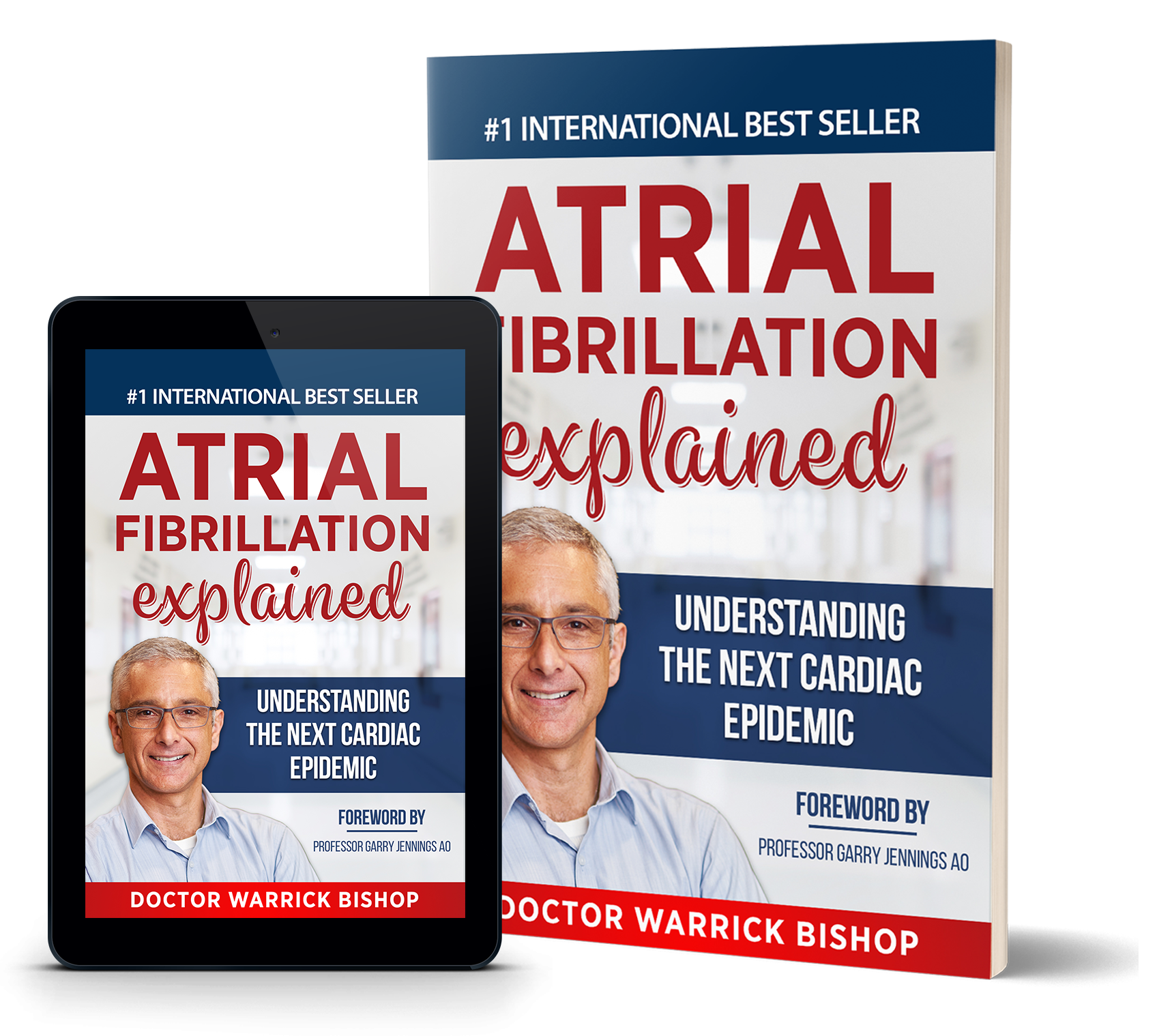
Welcome to Dr. Warrick's podcast channel. Warrick is a practicing cardiologist and author with a passion for improving care by helping patients understand their heart health through education. Warrick believes educated patients get the best health care. Discover and understand the latest approaches and technology in heart care and how this might apply to you or someone you love. Hi, my name is Dr. Warrick Bishop and I'd like to welcome you to my podcast station and to the Healthy Heart Network. Today I'm following up on a podcast called Why Me? where I had the opportunity in the first part to speak with Dr. Alistair Begg about coronary artery disease, atrial fibrillation and cardiac failure. Alistair has joined me again for part two of Why Me, and I'd like to welcome Alistair to the show and for joining me today. Thank you for being here today, Alistair. Thanks for having me again, Warrick, and lovely to be here once again. Look, quick recap. When we got together last time, we spoke about coronary artery disease as probably the main cause of heart attack. a layman term, which really just recognizes that something major has gone wrong with someone's heart. I think we recognize that the heart is a little bit like a car engine. It's got fuel lines, which are the arteries, main cause of coronary artery disease. There is an electrical system for the timing of the heart. And we talked about atrial fibrillation, a discordant electrical problem with the atria or the pre-pumping chambers of the heart. And we're also going to talk about cardiac failure today. But back to atrial fibrillation first and pick up where we left off. So just a quick reminder for those listening, Alistair, what is atrial fibrillation? Sure. Look, atrial fibrillation is a condition that occurs when the heart rhythm goes out of rhythm. The back chamber, instead of beating nice and regular, starts to get very irregular, and therefore the front chamber gets to become very irregular. And the two sort of important things to notice about atrial fibrillation is that it produces symptoms such as breathlessness or fatigue or maybe some ankle swelling or dizziness, so-called sort of pump problems, and also... It can lead to blood clots because the heart's not emptying properly and blood can pull inside the back wall of the heart and can cause stroke. So it's important that it's picked up and the blood's appropriately thinned down. So this is a common condition. And as you know, because we were talking about it off air, I've recently written a book on the subject of atrial fibrillation. So if anyone wants any more information, I can... You can find plenty of information on my website about it. But one of the things that struck me is this is a condition that affects 1% of the population and 15% to 20% of the population over 80 years of age. We're talking 300,000, 400,000 or 500,000 people in Australia. So this is a significant condition with an enormous morbidity attached to it. It really is becoming a major, major problem, certainly in my practice and I think in the Western world and I'm sure in your practice, Alastair. Yes, Warrick. Well, look, it's probably the most common ear condition that I see in my clinic. And it's certainly overtaken heart failure and heart attacks as the commonest cardiac presentation to hospital now. So it's becoming increasingly more of a problem as we move along. So this podcast is called Why Me? Tell me Alistair, why do people get atrial fibrillation? Sure, Warrick. Well, that's a very good question. And when my patients come along, I look at all their what's called cardiac risk factors in the same way that I do for someone who's had a heart attack or someone that's had high blood pressure. And essentially, I mean, part of it is your genetics, your makeup, your DNA that determines. whether you are going to get atrial fibrillation if you've got family history of atrial fibrillation particularly in younger members particularly when there's no other factors that might cause atrial fibrillation then we know that there are certain genes that make you more likely to get atrial fibrillation but there's also a lot of lifestyle factors and certainly we all know that obesity is becoming the new epidemic of this of this century And we know that for every 10% gain in body weight, there's a doubling of the risk for atrial fibrillation. Likewise, for those with atrial fibrillation and overweight, if they lose 10% of their body weight, it halves the risk. So atrial fibrillation and obesity are very, very much linked. We also know that alcohol use increases the risk for atrial fibrillation, probably about every drink that you have of alcohol. If you're susceptible, increases your risk by about 8%. And we know from studies looking at teetotalers versus those that drink alcohol, that there is a direct link between the amount of alcohol consumed and the risk for atrial fibrillation. And there's a number of other so-called risk factors that we look at, such as high blood pressure, diabetes, stress. they all can impact on the risk for atrial fibrillation. Certainly the big three for me when I see patients are obesity, which I think is often associated with poor sleep or sleep apnea, where the airway gets closed because of too much weight around the glottis and throat. And these patients don't sleep well. So obesity together with poor sleep, I think is a big player. Blood pressure is a really big player in my experience. And my experience also supports alcohol as a significant contributor. And beyond that, you're exactly right. Stress is a huge risk factor for developing this condition. But when we're talking about why me, Do you ever come across patients who seem to have atrial fibrillation and you don't have an excuse for it or can't figure out why? Sure. Well, look, you always do a thorough search for looking for causes. And often we put people through, as you say, obstructive sleep apnea may not be that obvious. And it's said that every patient with atrial fibrillation should have a search for. obstructive sleep ap because that's certainly for people that don't have an obvious cause that's often one that's not necessarily considered but there probably are genetic factors for atrial fibrillation that we don't yet understand we know there are some genes that are associated with atrial fibrillation but you know it's basically an electrical problem that has a cause And unless we sort of know the causes, we say it's unexplained, but there's always a cause for these conditions. Yeah, that's true. So when someone does present with this condition, what are the first things you're trying to do to manage that condition in terms of reducing the risk of recurrence of atrial fibrillation and also managing the condition both the symptoms that people get? And the prognostic concerns with risk of stroke. What are the things that you're doing immediately off the bat when you see someone with atrial fibrillation? Well, certainly, you know, when they first come along, you have to assess their risk for complications. And, you know, certainly the number one risk that we all know about and we've all seen is people having strokes as a result of atrial fibrillation. what the patient's risk is for stroke is one of the first things that I do. And there's various sort of risk scores that are available now. Most people that have been assessed will have a risk score for clotting and stroke. And then an assessment is made about whether that patient should be commenced on a blood thinner to reduce their risk of stroke. And that's really, I guess, the first thing, even if there's no symptoms, we still have to assess that risk. Secondly, we have to look at what the symptoms are and manage those symptoms. And that may involve correcting the heart rhythm or possibly controlling the heart rate. And there's various reasons why we might choose a heart rhythm control strategy versus a heart rate control strategy. And also managing any other complications that might arise as a result of atrial fibrillation. So if there's been a fluid buildup, maybe some addition of some... medication to get rid of fluid, to control associated blood pressure and other factors, and more just general lifestyle advice about weight and alcohol and exercise and those sorts of things as well. And along with an assessment of the heart structure and function, which is usually done with an ultrasound and possibly may involve some sort of exercise test or testing of the arteries that supply your heart muscle as well. So my experience would be as we're seeing patients get older and older, we know that average life expectancy is increasing and we know that the average patient age that we're seeing is increasing, which is testimony to our intervention and our care over the last decades. I'm starting to see more and more patients who have had a coronary event in their maybe 50s or 60s or early 70s. who then develop some atrial fibrillation and then develop cardiac failure. Now, cardiac failure is a bit of a scary term, and we talked about it being representative of the compression chamber of the heart, the pistons and valves, the engine block, if you like, of the heart not working properly. Cardiac failure is a scary term, but I'm going to now lead on to cardiac failure. and ask you how you describe cardiac failure to your patients. Sure. Well, look, there's lots of definitions about cardiac failure. Essentially, it's a situation where the heart is unable to keep up with the demands of the body. And that could be a situation where the heart is either getting weak or possibly not functioning efficiently due to a disturbance of rhythm. or possibly is inefficient due to a leaky or narrowed valve. And they're the usual sort of causes, and sometimes it's due to just excessive blood pressure demands on the heart. But whatever the cause, the end result is that the body's not getting an adequate amount of blood flowing around it. And this leads to various symptoms, such as shortness of breath, fatigue, sort of swelling of the ankles, and perhaps loss of appetite, sometimes... A person may experience some palpitations or other sort of vague symptoms. And then the challenge is really to work out what's causing it and how you manage those symptoms. And also in the process of working out what's caused it, you then lead to a process of working out. If you can work out what the cause is, then you have to work out what can be done to correct that cause as well as treating the symptoms. That's true. Look, I'm going to break it down a little bit for the sake of the Why Me podcast title. And really, cardiac failure can be related to people having past heart attacks, which we spoke about in the first part of this podcast. So if you damage the heart muscle, it won't work as well. And so that can lead to cardiac failure. High blood pressure, as you said, overloading the heart, problems with the valves, as you said, but problems with the electrical system. So if the heart races, a bit like atrial fibrillation, that can kick off cardiac failure as well. There are congenital or hereditary causes of cardiac failure, as you're aware of, and other issues like infections, which can be bad luck, or toxins like... Well, alcohol that we mentioned for atrial fibrillation can also impact the heart. So the why me for cardiac failure can be that you've suffered the other conditions and eventually ended up at the final common denominator. Sure. Well, that's true. I mean, certainly there's always a cause somewhere along the line. Once again, it's a bit like atrial fibrillation. There's always a cause of heart failure. And by trying sort of logically to work that out, then you can more correctly treat the heart failure rather than just giving a general symptom control. If you can target the cause, then you can appropriately manage the patient. And there are some sort of standard principles for treating heart failure, but the types of heart failure and the different causes really determine what that specific or bespoke approach to treatment really is. Yeah, I understand what you mean with that because we do need to tailor to individuals' needs. But I guess in general terms, some sensible things that we would often recommend would be reduction of alcohol if alcohol consumption is a factor. We'd certainly look at blood pressure control. We always want to keep blood pressure down because that's the work that the heart does. And we always look at exercise and asking people to be engaged in exercise because for all the conditions we've discussed. Being physically active and having some sort of exercise regime or routine is beneficial. On top of all that, you and I both know that the stress of illness and the stress of life can impact our cardiac health. And so we always keep an eye to making sure our patients are emotionally as well as they can be for the given situation. Look, I'm going to... Because of time, I'm going to start to wrap up here, Alistair. I think we've covered a lot of information on atrial fibrillation and we've had a good run through cardiac failure. Was there anything else you wanted to just throw out there as a final remark or a parting comment? Yeah, look, I think at the end of the day, whatever we do as cardiologists is about trying to, improve symptoms, improve prognosis, and that might be looking at sort of functional testing or anatomical testing of the heart. And our decision is really based on all these factors. And so it's important that you give as much information as you can to your doctor so they can really make the most educated decision about your treatment. So I think that's the, I guess, the final comment from my point of view. And I wish all of your listeners the very best in their journey towards heart health. Alistair, I couldn't have put it any better myself. Thank you so much for sharing your wisdom and knowledge around those subjects. I'm going to wrap up to... Those listening, if you have any queries or questions, please drop us a note on members at Dr Warrick Bishop online. If you've got any suggestions for future podcasts, please feel free to let us know. As always, I wish you the very best health. Until next time, take care, goodbye, and please don't die from a heart attack. Bye now. You have been listening to another podcast from Dr. Warrick. Visit his website at drWarrickbishop.com for the latest news on heart disease. If you love this podcast, feel free to leave us a review.