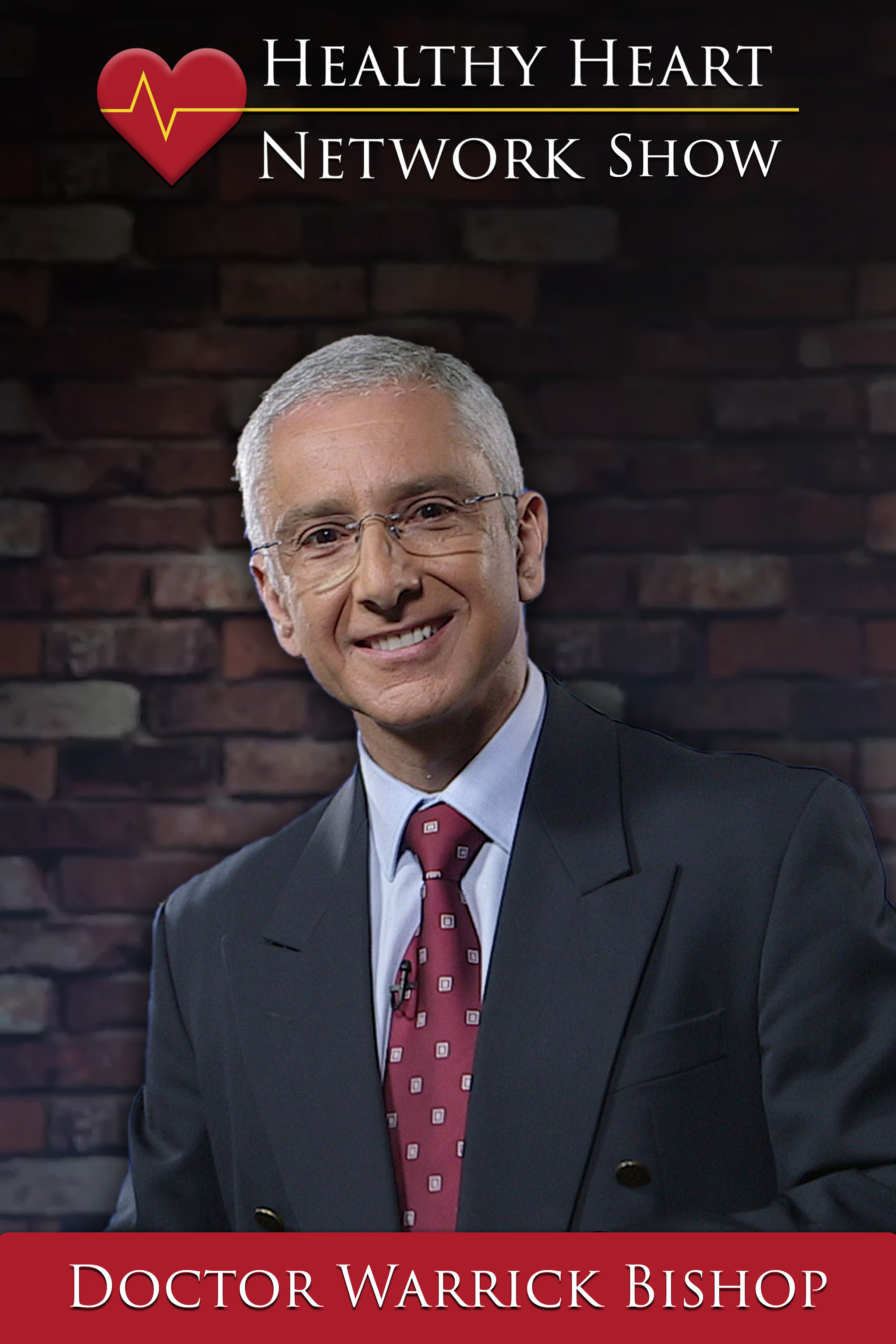
[0:00] Welcome, my name's Dr. Warrick Bishop. I'm a cardiologist, I'm an author and a keynote speaker. I'm CEO of the Healthy Heart Network. I'm all about trying to help people
[0:12] Live as well as possible, for as long as possible.
[0:15] Heart disease is huge in Australia.
[0:18] Every 20 minutes someone suffers a heart attack. Most of these could probably have been avoided if only we knew what to do. This podcast is all about helping you understand blood pressure, weight, cholesterol...
[0:32] for better health.
[0:33] If you enjoy this podcast, I would be honoured for a five-star review.
[0:37] you can share it with your family and friends. It may well save.
[0:41] someone you love.
[0:42] Hi and welcome to my podcast and videocast station. It's Dr Warrick here but you probably know that otherwise you wouldn't have hit the right button. What I'd like to do is thank you for joining me and what I'd also like to do is thank Claire Myers for joining me today. Claire is the chair and president of...
[1:02] Parkinson's disease Tasmania and it really is my privilege and honor to have her join me today to talk about Parkinson's disease and some aspects that you may not have known about. One of the reasons I'm really grateful for Claire joining us is my dad
[1:22] has Parkinson's, is attached to some of the supports that are offered, and I've watched him and his journey with his condition, and there's a lot to share. Claire, welcome. Thank you so much for joining me.
[1:36] Thank you for having me, Orc.
[1:38] Claire, look, um...
[1:41] I think I'm sort of curious to know how you became president and chair of the...
[1:48] Parkinson's Disease Tasmania organisation. What's your background and how did this come about?
[1:54] So I'm a lawyer by trade, but please don't hold that against me. But my work with Parkinson's Tasmania is very personal. My dad...
[2:09] Also had Parkinson's and I guess as a family, we went on the Parkinson's disease test.
[2:18] journey together.
[2:19] and Dad was diagnosed in his late 50s.
[2:24] and really lived a very healthy, happy, active life.
[2:30] loss,
[2:31] even though he had Parkinson's. He travelled widely. He ended up being part of the Grey Nomads, trekking around Australia with mum, very involved in our family and with his grandchildren.
[2:48] But we did face a lot of challenges as dad's Parkinson's progressed.
[2:54] Um, and whilst he's not here with us anymore, I really wanted to pay it back or pay it forward to the Parkinson's community because, um,
[3:05] It was a hard journey and oftentimes Dad felt alone and our family felt alone. So really advocating for people with Parkinson's.
[3:15] and making the journey, even if it's just for one family, easier.
[3:21] then certainly my
[3:24] My mission is working. So it's a very personal thing.
[3:31] reason why I'm involved in the Parkinson's community.
[3:35] Yeah, look, thank you for sharing that, Claire. And I think anyone who's listening would realise...
[3:41] To a large degree, people who make a difference in our world, and I'm referencing someone like yourself, will do it from a position of passion. And that really sounds like...
[3:51] A significant journey you watched your father travel. I guess there'll be people who don't know anything about Parkinson's disease out there and they might have heard of Michael J. Fox or they might have seen very elderly people in nursing homes with a tremor and that's the only experience they've got. As I listen to you, Claire, I'm going to say that.
[4:13] I had the impression that your dad's journey was over a good period of time.
[4:20] Would you like to just speak to what some of the common challenges are for people with Parkinson's disease, how there are significant differences and variances between individual patients?
[4:32] people's
[4:33] journey. Because it's obviously more complicated than Michael J. Fox and someone who's really old in a nursing home.
[4:42] Sure. I mean, there's lots of things to unpack there. I think a lot of people have this picture of an older gentleman with a shake hand
[4:51] a tremor
[4:52] Um, and I guess that's one of the key things that we're trying to educate and inform people is, um,
[4:58] to break that stereotype.
[5:01] Um,
[5:03] Parkinson's affects men and women and it's not just older people. We're seeing more and more that people
[5:12] are getting diagnosed with Parkinson's early. There's sort of a common language around early onset or young onset Parkinson's where people can be diagnosed early.
[5:24] in their 30s and their 40s and their 50s. And that may be that we're actually just getting better at
[5:31] identifying and diagnosing Parkinson's as a science and the research evolves.
[5:39] But certainly educating people that it is...
[5:43] a plethora of our and cross-section of our population that is impacted by Parkinson's.
[5:49] Another key thing that people don't realise is the prevalence of Parkinson's.
[5:54] It's actually the fastest growing neurodegenerative condition in the world.
[6:00] which is quite terrifying really. And we think there's about 200,000 people in Australia that actually have Parkinson's.
[6:08] We don't have great data on what that looks like, but we're working at a national level to make that
[6:13] data more accessible and accurate.
[6:18] And I guess, too, there's an adage that's out in the community. You've met one person with Parkinson's.
[6:26] you've met one person with Parkinson's because there are so many different ways Parkinson's shows up for people. There's motor symptoms, so that the movement, the tremor, the...
[6:39] the stiffness, the change in the way that you walk and move your body.
[6:44] So the typical motor movement symptoms, but there is also a huge amount of non-motor symptoms involved.
[6:53] that show up as well.
[6:55] in terms of...
[6:57] uh,
[6:59] depression, anxiety, something that's referenced as apathy, which is just almost like a non-reaction, emotional reaction to things. So I'm learning a lot about apathy at the moment.
[7:11] So there's a huge amount of different characteristics of Parkinson's and there's no one...
[7:20] diagnostic test a lot of it's very much observational and it can take a really long time for people to actually get a diagnosis of Parkinson's which can
[7:32] obviously be very challenging.
[7:34] And also, too, once you're diagnosed with Parkinson's, where do you go from there? What happens next?
[7:41] Thank you.
[7:41] Look, Claire, if I can tease you out on a couple of those things, and it might be interesting for those who are listening,
[7:48] One of the things that you said with Parkinson's being the fastest growing chronic neurological disorder, is that...
[7:56] Is that talking to a percentage of the population who will get Parkinson's in their later years
[8:04] and there are more people hitting later years and therefore the numbers are increasing? Or is the percentage of people within the population...
[8:14] actually increasing so does that make sense do you understand it's so I think so I guess it's a little bit of both as far as I'm aware so certainly age and aging is a key factor in a risk factor I guess for Parkinson's so we do see that mainly as people age the risk of Parkinson's
[8:43] Parkinson's increases.
[8:46] So as we're
[8:47] getting older in our society. And this is a huge challenge for Tasmania, of course, because of our ageing population. So age is certainly a risk factor.
[8:59] We're also becoming more and more aware of environmental risk factors that seem to be having, and there's a lot of evidence...
[9:07] out there about how our environment is actually increasing the risk of developing Parkinson's.
[9:14] In the past, a lot of people thought it was purely genetic.
[9:18] There is, I think it's about 10% to 12% genetics,
[9:23] are part of a potential risk.
[9:27] factor, but more and more so we're seeing that our environment, including toxins, pollutants,
[9:38] Um,
[9:40] can contribute significantly to an increase in risk for our population, which is quite scary, really.
[9:48] I imagine some people may also relate Parkinson's to Cassius Clay or Muhammad Ali, so trauma potentially having an impact.
[10:00] perhaps multifactorial, um...
[10:03] or different insults to the brain may lead to this condition. Look, one of the things you also said was...
[10:12] Um...
[10:13] Things like depression and apathy and anxiety are real key players. And I'm not sure that I was aware of that.
[10:22] I'm sure that many of the people listening to this may not be aware that that's the case.
[10:28] Do those sort of
[10:29] conditions do they present very early or even before the movement disorders or do they tend to come later and potentially quite an understandable response of an individual who's confronted with a
[10:50] It's a really great question.
[10:57] as I understand it, and I'm not a medical practitioner, is that it's different for everyone. So especially in women...
[11:07] Often women in their 40s and 50s are presenting with anxiety, depression, anxiety,
[11:13] And it's brushed away as perimenopause or menopause or...
[11:18] Just take some Lexapro and have a lie down and chill out.
[11:24] So but it is very much a key identifier of Parkinson's. So anxiety, depression and apathy. Some people might not suffer from any of those symptoms.
[11:38] in their Parkinson's journey, others may get a triple whammy. You know, everyone is different.
[11:46] But I guess to wellbeing after a diagnosis, I think,
[11:51] could trigger then
[11:53] anxiety and depression,
[11:56] post-diagnosis. So it is, it's not...
[11:59] black and white, I guess, one could follow the other. I think one of the things, and this was certainly something that,
[12:06] I have learned more about recently and reflecting on dad's journey, I could see this concept of apathy now.
[12:15] Dad's...
[12:17] was probably a...
[12:21] He was a beautiful gentleman, quite creative, creative,
[12:26] quite artistic, very great with his hands, deep thinker. But as his progression, and quite emotional just generally about things in a very positive way, very loving and caring. But as his Parkinson's progressed, he's,
[12:44] I saw that being chipped away and it eroded over time. And quite a personal story and it still sticks with me. When our second son was born, I said to Dad, we've...
[13:00] chosen his name
[13:01] And his second name is Christopher.
[13:04] Which was Dad's Nine.
[13:06] And Dad went, oh, okay.
[13:09] And I was like, with 19...
[13:11] You know, in...
[13:13] On a review, Dad. And he's like, okay.
[13:16] And I'm like, that is not the response I was expecting. So just elements like that, and, you know, he's been gone now for a little while.
[13:26] But...
[13:28] As I learn more about Parkinson's, and I literally learn something new about Parkinson's every day, it is crazy. And the world's starting to catch up. We hear a lot about MND, we hear a lot about MS, but not so much Parkinson's and Parkinson's
[13:45] That's a really curious thing for us to unpack as a society. There's so much stigma. People don't want to talk about their Parkinson's.
[13:54] And the MND world has been so incredibly blessed by the Neil Jannaher's of this world.
[14:01] And so we've really got a big job ahead of us to share information about the
[14:07] what Parkinson's looks like, that you can live well with Parkinson's. And it often is a very long journey, you know,
[14:16] So,
[14:18] I guess...
[14:20] equip yourself with knowledge and, um,
[14:23] Learn as much as you can and get out there and get active and connect with people too.
[14:30] Don't do this on your own. There's lots of people out here
[14:35] that know what it's like. So, yeah, that's another big piece too around wellbeing is this sort of
[14:43] People generally become quite socially isolated. And in Tassie, that's a big challenge, of course, in lots of communities. But, yeah, there's...
[14:56] I guess the wellbeing part of the journey is something that we're really actively advocating.
[15:04] Well, indeed, Claire, we connected through that wellbeing journey.
[15:09] I don't know.
[15:10] You've talked a lot about some of the aspects of Parkinson's and some of the features from my training. I won't even mention how many years ago, but my recollection is there were three...
[15:22] key movement issues that define Parkinson's. And if my memory serves me correct, I...
[15:30] One was tremor. So the shake, um,
[15:35] One was hypotonicity, and for people listening, that means stiff muscles. So your arms move slowly, they're stiff, hypotonicity.
[15:46] Um...
[15:47] And the other thing was bradykinesia. And bradykinesia means moving slowly. Brady meaning slow, like in a bradycardia, slow part. Bradykinesia, kinesia meaning movement, slow movement. So you and I really connected through a service that my wife and I offer through a wellness center we have in town
[16:17] radicarnesia and tremor,
[16:19] and stiffness can cause things like poor mobility, things like increased risk of falls. And these are really big loss of muscle problems.
[16:32] loss of muscle tone, loss of flexibility. Would you like to speak to that for a moment, Claire? Because these are really big things in the quality of life that people have. It's about...
[16:45] independence. It's about...
[16:47] It's functional capacity. It's about, are you able to bring your own shopping in? Are you able to play with the grandkids? These are huge, huge components that we take for granted while we are well, but these are confronting people with Parkinson's all the time.
[17:06] Absolutely. You've pointed out so many key things that are front of mind for our Parkinson's community and care partners as well. And the families that wrap around them and the support that wraps around them. You mentioned falls. That's a huge risk for a lot of people in our community. So if you learn more and get stronger...
[17:29] around mobility and strengths,
[17:35] you know, you reduce the risk of falls or at least learn how to fall safely or if you do fall, get up safely. So there's...
[17:44] And it depends where you are on the trajectory of your journey as well.
[17:49] But I think the sooner you get onto all of those things...
[17:52] the better. We hear every day in our community how people want to live independently.
[17:58] and at home.
[17:59] and be strong and well and healthy.
[18:04] So they're all the things that we advocate. So we definitely connected over those things. And I must say, I've been into Warrick's
[18:14] incredible wellness centre in Hobart and get down and see it. I, as a busy mum of two little boys, I took the...
[18:24] the time to sit on one of their beautiful vibration beds with a red LOD mask thingy on with some music in my ears and I was transported. And I think every busy working parent should actually just come and lie on there for 10 minutes and...
[18:40] day stress.
[18:41] But what a beautiful place to go and learn how to be strong.
[18:48] And I spoke to some of your amazing staff and I know that you have lots of people that come in with Parkinson's and Parkinson's.
[18:55] some very competitive people that come in with Parkinson's and they like to see their star or their name at the top of the list that you have up on the wall there. But falls are huge.
[19:09] Mobility is very challenging and then if you're not mobile, then it exacerbates things like social isolation, anxiety,
[19:17] reliance on others, the stigma that comes with that,
[19:20] So making sure that you are mobile is really important. And again, as we talked, it's different for everyone. So my dad didn't have a tremor.
[19:30] He presented with a stiffness on
[19:33] In his left hand,
[19:35] arm and his left side of the body. So, but that really changed the way he walked and his gait.
[19:45] So, I mean, again, it presents differently for everyone, but I think...
[19:51] wellness and strength in your body.
[19:53] body is one of the key things to...
[19:56] staying independent. So, again, we're always actively advocating for getting out, getting active, getting
[20:04] Um,
[20:05] And when people are diagnosed, one of the best, the most consistent pieces of advice, and we know that it,
[20:11] can...
[20:12] slow down the development of Parkinson's. There's some really great evidence around that, but to
[20:18] Make sure that you do quite physical activity.
[20:21] as well, might get the heart rate up.
[20:24] So all these things are really important to learn more about.
[20:28] just generally for health, I think.
[20:31] I should probably get my heart rate up a little bit more often. We all should, Claire. We all should. We all should, but certainly it's a big thing for people with Parkinson's. What I might add in there is our centre not only helps with strength and balance, muscular strength and balance, but we're also building bone strength. And if you do, by chance, have a fall, having some extra strength in the bones could be the difference between a hospital stay and the complexity of that.
[21:01] a bruise and being able to get home so we we really see our opportunity to help people with parkinson's disease and other actual uh actually other chronic neurological degenerative conditions we see that as a great opportunity and we feel really proud we can do that look what i was we're in the interest of time claire and i normally i normally only run these for about 10 or 15 minutes
[21:31] about it will ignore the the normal timelines but I've got I'll finish on two questions or two questions for you seeking your comment the first would be for anyone listening if they were recently diagnosed with Parkinson's disease what what would you say what would be your advice and I
[21:54] And then really importantly for anyone who may be listening, who's family of someone who's recently married,
[22:01] being the recipient of a diagnosis of Parkinson's. So you've got two...
[22:07] two comments, two shares there that you would give to the patient and to their loved ones. What would you say?
[22:19] You're not in this alone.
[22:21] um,
[22:23] And a diagnosis is terrifying, I guess. But we also hear too that a lot of people feel like it's a bit of a relief.
[22:31] Some people have been like, "I've just not been right for a while and I don't know what it is or why."
[22:37] often it's taken them a while to get
[22:39] an actual diagnosis.
[22:42] Um,
[22:44] So there's a lot of different emotions that people feel.
[22:47] and work through a sense of grief for a lot of people as well. Like, what does this look like?
[22:53] Um, so...
[22:55] I guess the first question is you are not alone and...
[23:00] Um,
[23:01] There is a strong community here in Tasmania that can...
[23:06] support you, help refer you to...
[23:11] Okay.
[23:12] especially allied health professionals and others in the community that...
[23:17] Um,
[23:18] can support you
[23:20] through your journey, depending on where you're at and what things you like to do and don't like to do and...
[23:27] So,
[23:29] I guess...
[23:31] We have at Parkinson's Tasmania a community hospital,
[23:36] operations officer and she works a few days of work. Her name's Jackie. And so I'd encourage people to reach out to Jackie. I can give you the phone number over...
[23:49] Over the podcast now is 0428 981 933. So ring Jackie and if she doesn't answer straight away, she'll give you a call back. Give us that number one more time, Claire, because if people listening or anything like me, it goes in my ear and out there. Grab your pen. Grab your pen and paper, 0428.
[24:11] 981
[24:13] So give Jackie a call. We can't give clinical advice, but we can certainly provide support and referrals on. We also work very closely with a Tasmanian lifeline, which they've actually been trained specifically to deal with patients.
[24:33] what to deal with.
[24:35] Um,
[24:36] taking calls from people that have Parkinson's and their care partners. So that's a beautiful collaboration that we've evolved recently actually. So a Tasmanian lifeline for that wellbeing support. We also have a website and a Facebook page, but really just reach out and make some connections. We also have support groups in Hobart, Launceston and Olverston that meet once a month.
[25:03] That's for people with Parkinson's. And we also have a carers group that meets quarterly as well in those locations.
[25:12] Depends what your jam is. Sometimes people like...
[25:15] getting online and finding out things. Some people like talking. Some people like connecting face-to-face.
[25:21] So if you've been diagnosed, then reach out and we're here to listen and support and advocate for you.
[25:31] For those like me that when my dad got a diagnosis, I hadn't even really heard of Parkinson's before.
[25:40] I jumped online and found out about Parkinson's Tasmania.
[25:45] Which has actually been...
[25:46] around for 40 years. We've actually been operating for 40 years. And a wonderful lady called Pauline rang me.
[25:57] and had a chat.
[25:59] And she's one of our...
[26:01] volunteers who's
[26:04] You know...
[26:05] Near her 80s. She's been working as a volunteer for 40 years for Parkinson's Tasmanian. Just exceptional. She's an incredible lady.
[26:13] So she's actually the vault of so much information. She's the Oracle. She signed me up with the Parkinson's Tasmania quarterly journal. So I got a newsletter to my home.
[26:24] And for me, that was enough at the time, just understanding more about Parkinson's.
[26:31] Um...
[26:32] and learning or trying to navigate quite a...
[26:37] Quite a tricky pathway to make sure Dad had support.
[26:43] Someone that's...
[26:45] And
[26:46] a loved one, a family member, a close friend,
[26:50] And the journey is very real for you too.
[26:54] Um, so again, reach out to Jackie, jump on our website, follow us on socials.
[27:00] There's lots of different ways that we can connect and you can get the information that you need.
[27:06] Um,
[27:08] Hopefully to help the journey be a little bit less bumpy.
[27:12] And not to feel alone, I guess, would be the two...
[27:16] things from those perspectives.
[27:19] Look out.
[27:21] I really value the sharing and the information you've given us today, but it almost strikes me in summary that,
[27:30] There's probably more Parkinson's disease out there than we've realised.
[27:34] that it's variable in the way it impacts people. It can be a Michael J. Fox scenario. It can be...
[27:45] the old man with a shake in a nursing home, but there are so many people. They're the extremes. It seems like the bunch of people actually exist in the middle and deal with this over a period of years and sometimes even decades. And from what you've said, Claire, support is key to these individuals and for the carers to have the best possible outcome.
[28:13] And that support, Parkinson's Tasmania obviously can direct people. Looking after yourself physically and emotionally is huge.
[28:23] And it's a journey for everyone. I really thank you so much for sharing. Is there anything else you'd like to put out there, Claire, as we wrap up?
[28:36] No, I guess, well, I say no, but yes, thank you for having me. I've always got something to say.
[28:44] I just thank you so much for the generosity of having this podcast today, Warrick, and I think there's so many out there in our community.
[28:55] that are passionate about making a change.
[28:59] Um, and yeah, I,
[29:03] There's a huge road ahead of us, but someone said the other day it's just the...
[29:09] End of the beginning, which I think someone famous might have said that actually. But we've got a lot of work ahead of us, but we can do great things together. So we're always keen for people to get in touch with us.
[29:23] If you've got your own journey or you'd like to help
[29:27] Mike.
[29:28] Um,
[29:29] As I said, we're entirely voluntary at the moment, so if anyone ever wanted to reach out to us and, you know, give us a whole heap of cash to do something or get involved as a volunteer, please.
[29:41] Hopefully you'll see more and more of us as our work and visibility increases. And we're really a very collaborative community.
[29:53] bunch. We work really closely with the university and the state government and other incredible community organisations and we're definitely stronger together. We're small but we're mighty here in Tasmania so hopefully we can make great things happen together.
[30:11] Okay.
[30:12] Claire, thank you once more. For those listening, I'm sure you've learned something about Parkinson's. If not, you've been moved.
[30:20] by the passion
[30:22] um that claire has in this space so uh claire myers who's chair and president of parkinson's disease tasmania i'd like to thank you one last time for joining me for those listening um i know you will have got something from it as always i really appreciate you hanging to the end i know that everyone's time is valuable if you've got any queries or questions or suggestions for future podcasts let us know but for now i'm going to wish you the very best i do hope you live as well as
[30:52] as possible. Take care.
[30:54] and buy for now. Hi, ever wondered what your risk of heart attack is? You should. It's the single biggest killer in the Western world. We're talking one death.
[31:06] less than every 30 minutes in Australia one death
[31:09] less than every 60 seconds in the United States, 9
[31:14] million deaths globally.
[31:16] per annum. Well how do you check your risk? Well you can go to
[31:21] www.virtualheartcheck.com.au. You'll find out about your risk and what can be done beyond that to be even more precise.