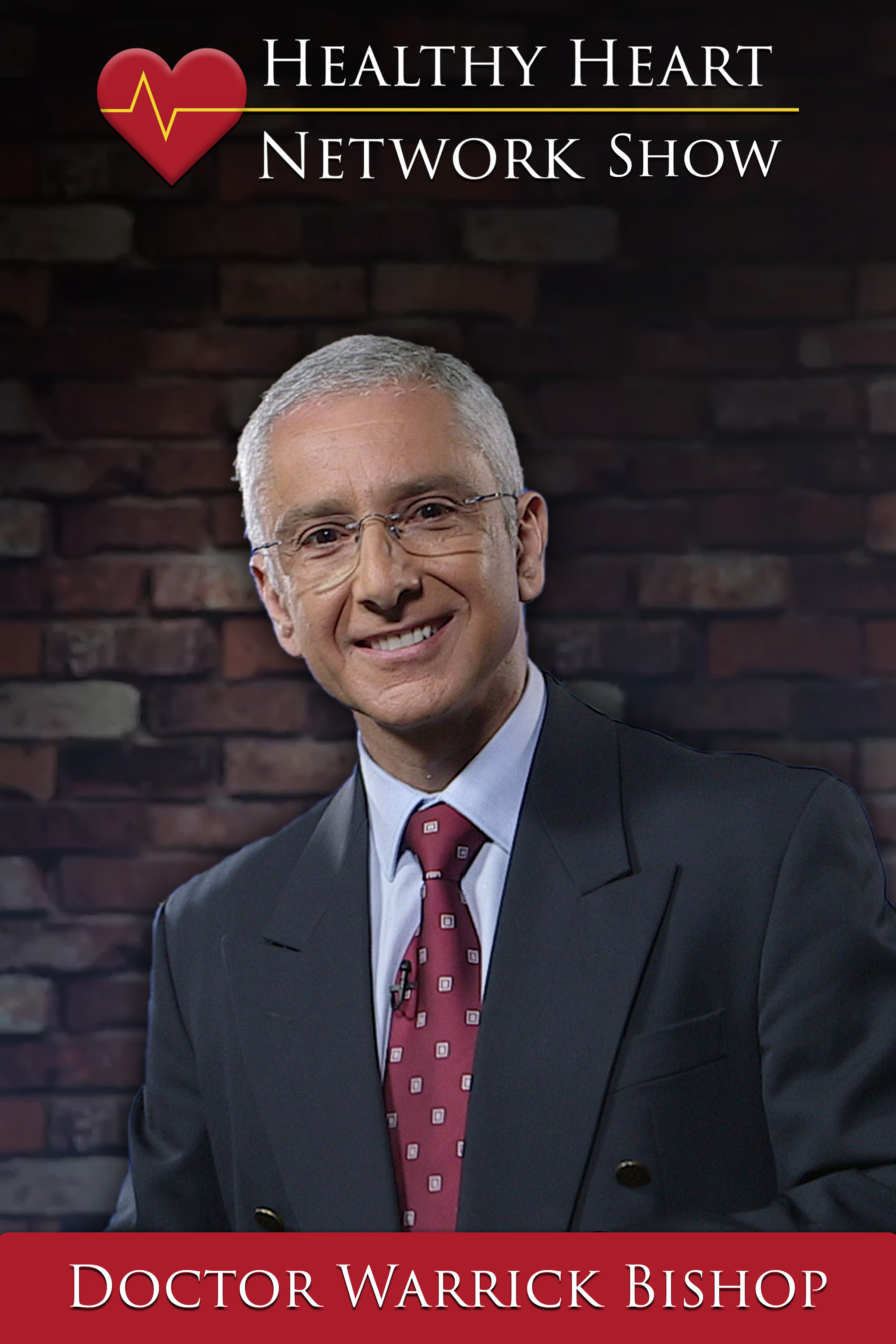
Welcome to Dr. Warrick's podcast channel. Warrick is a practicing cardiologist and author with a passion for improving care by helping patients understand their heart health through education. Warrick believes educated patients get the best healthcare. Discover and understand the latest approaches and technology in healthcare and how this might apply to you or someone you love. My name is Dr Warrick Bishop and I'd like to welcome you to my podcast station, my videocast station and of course to the Healthy Heart Network. Today I'd like to talk a little bit about salt. I was recently at the Cardiac Society of Australia New Zealand meeting in Adelaide and was privileged enough to be at a lecture given by Professor Bruce Neal. a world expert in salt. And what I'd like to do is share very briefly some of the points that he covered in the lecture. So the presenter of this particular lecture was Professor Bruce Neal. He titled the lecture Salt, Preservative or Poison. And I went along to this lecture because you do hear different things about salt. Some people saying it's a problem, particularly on a population-based scale, but other people saying that it's variable between different individuals. Some people are responders, others are non-responders. So I was interested to go along. I'm very interested in blood pressure these days as there's no question it's an important risk factor that we should be trying to. address as much as possible, as often as possible. So Professor Neil, when he started off, talked about normal concentration of salt in our diet in an evolutionary perspective. He didn't talk about normal consumption of salt in the year 2019 in the Western world. He went back and talked about consumption of salt. three million years ago, two to three million years ago, when we were first evolving, when we would have been hunter-gatherers on the African plains or the equivalent, scavenging for food, hunting for food where we could. All those years ago, he suggested that the amount of salt we would eat per day would be about one gram. And with that, His suggestion, quite reasonably, was that our evolutionary development was around how to deal with one gram of salt per day. Well, humans have started to produce salt, and we started probably a thousand odd years ago. And since that time, and particularly in the last hundreds of years, we've produced more and more salt. We use it as a preservative and also as a flavour. Most importantly, We see it a lot in processed foods these days. So one of the examples that Professor Neil spoke of was the Yanomami people, who are a tribe living in the Amazon on the border of Venezuela and Brazil. Now, I didn't know where they were, but I've been educated too. These Yanomami people, Professor Neil suggested, are eating in the way that we were evolved to eat. And this means that they are truly hunter-gatherers eating very low amounts of salt over a lifetime. Now, the really interesting thing about the work that has been done observing these people by scientists... is that when they look at blood pressure measurements across different ages for the Yanomami people, their blood pressure starts at a lowish level at a young age, as one would expect, but it really stays fixed over decades. And so the average blood pressure of these individuals between the ages of 20 to 30 compared to the 50, 60-year-olds is basically unchanged. This is in stark contrast to what we see in the Western world, where if we look at the blood pressure of young adults compared to much older adults, there is a clear linear increase over time in blood pressure. Professor Neal's proposition is that this is related to salt. He then demonstrated with lots of... beautiful graphs and different studies that have been done over the years, a very clear link between increased salt consumption and increased blood pressure, and the reverse, the reduction of salt and the reduction of blood pressure in individuals. One of the things that he was talking about was the disease burden on a global scale that salt consumption appears to impact. What he was sharing was that the World Health Organization was suggesting that if we could reduce global salt consumption down to two grams per day, which is still twice what Professor Neil suggests is our evolutionary target, but if we could reduce salt to two grams a day on a global basis, we could save 2.3 million lives annually. on a global basis. If we were slightly less ambitious and got the target down to five grams per day, we'd still be saving half a million people around the world per annum. This is just incomprehensible. The suggestion from Professor Neil, based on the research that's available to date, is that we will see a small increase every year. in adults who are exposed to an excess salt diet of an approximate 0.35 millimetres of mercury blood pressure rise systolic year on year. This can be unwound to a small degree. In fact, by reducing salt and removing salt, we can get a significant improvement in those blood pressure levels and start to reverse that gradual increase. Well, there has been a lot of resistance to change and we know that it's very hard to find food without salt in it. And we know there's even been some confusion around is salt good, bad or indifferent. Well, there are vested interests and some of that vested interest is obviously driven by the money within the food industry as the food industry and particularly the processed food industry is an enormous industry. That industry has funded research, and I'm not going to suggest that it's been responsible for confusion of the landscape, but there's no doubt that those vested interests have taken opportunity to find any discrepancies in the research and use those to perhaps temper the debate. There was a large study called the PURE study, which really created a lot of concern about whether salt was such a problem or not. In fact, that study raised the possibility that you could have too little salt, and that might actually cause you problems, so that there was a sweet spot, if you like, for salt. Well, this PURE study, interestingly, measured salt consumption in a way that was different to other studies that have done it. At the time, the researchers, as far as we know, believed it was a rigorous way to do it. But it transpires that they used an equation to modify and calculate salt consumption based on spot urine analysis, rather than collection of urine over a 24-hour period, to be most precise. Those spot urine analysis results were put into an equation called a Kawasaki equation to then figure out salt consumption and the relationship between salt consumption, blood pressure and mortality in those individuals. It turns out that the pure study conclusions certainly suggested that there was a... No problem with consuming some salt, and if you took too little, you'd be a problem. But when they looked more closely in recent times at the role of the Kawasaki equation to derive the conclusions in that trial, it showed that that equation was actually unreliable, and to a large degree... The pure study based on the confounding effects of that equation and the way it was used is really a misleading study in the scheme of things. The really good thing is that Professor Neil is currently bringing together a major study which is a multi-centre, large-numbered, long-term trial. where they've looked very closely at salt consumption, properly assessed and regulated. And that study is not going to report for at least another 12 months, but it's in process. So it's a very interesting space, but based on everything that Professor Neil presented, there's no question I was impressed with the importance of reduction of salt in diet. It makes evolutionary sense. the confusion of the PURE study based on the inappropriate use of an equation that just ended up being a confounder rather than a contributor. And certainly the data observed from these primitive tribes who have no exposure to salt at all is very compelling. I suggest you add plenty of pepper to your egg sandwich, maybe hold on the salt. I suggest you keep well hydrated and look after those kidneys. We will watch this space because the salt question remains unresolved and I think it will be an interesting story in the longer term. If you have any queries or questions, of course, well, I hope you found this an interesting presentation. I certainly did. We're going to Professor Neil's lecture, so I hope sharing it with you has been interesting and informative for you. If you have any queries or questions, of course, let me know. And if you have any thoughts for any future podcasts, of course, also let me know. Until next time, of course, I wish you the very best, and please don't die from a heart attack. Goodbye. You have been listening to another podcast from Dr. Warrick. Visit his website at drWarrickbishop.com for the latest news on heart disease. If you love this podcast, feel free to leave us a review.